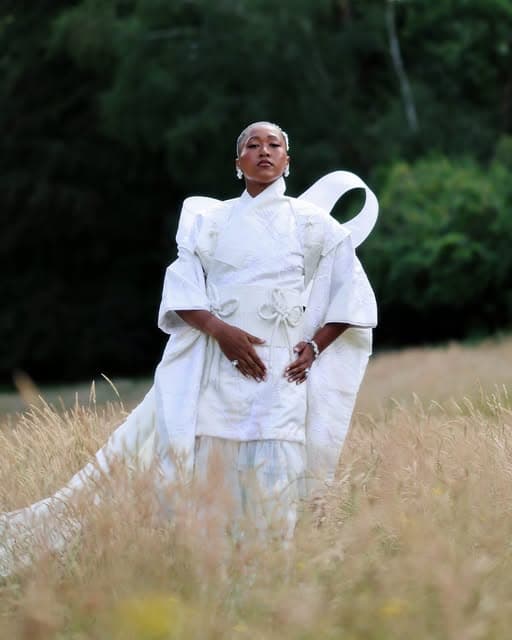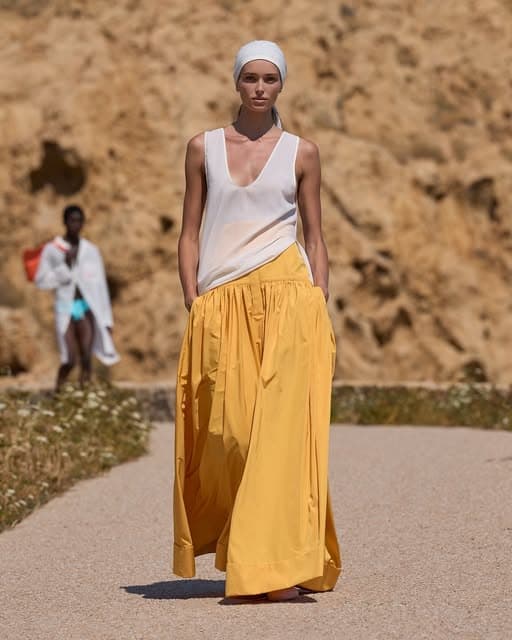
The Jacquemus Le Bonheur looks arrive with the clarity of morning light, that particular Provençal brightness that makes even a simple cotton feel like an event. Simon Porte Jacquemus called it a dream, a journey, and you can sense that intimacy in the clothes, not as confessional sentiment, but as discipline. Nothing here is messy. The emotions are edited, sharpened, hemmed. It is a collection that understands how to flirt with innocence without dressing like it.
“Le Bonheur” is not a mood board, it is a practiced kind of happiness, the kind you work for. The show’s message is folded into the construction: cinched waists that insist on posture, elongated lines that skim rather than cling, and a palette that reads like sun on limestone, fresh cream, butter, salted sand. There is pleasure, yes, but also restraint. That balance is where Jacquemus is most himself.
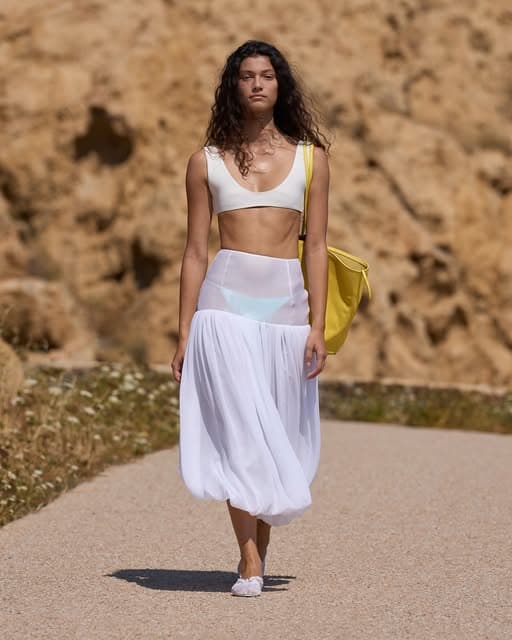
Jacquemus Le Bonheur looks and the art of controlled lightness
What makes the Jacquemus Le Bonheur looks so persuasive is their refusal to over explain. The silhouettes do not shout, they whisper in fluent French. A sculpted jacket holds its shape like architecture, while a skirt swings with a deliberate looseness, never collapsing into laziness. You feel the hand of a designer who loves the body, and loves even more the idea of framing it.
Jacquemus has always understood that sensuality can be clean. Here it is calibrated through proportion. A long leg line, a neat shoulder, a hem that lands exactly where it should. The clothes look effortless, but the effort is in the correctness. It is the kind of precision that reads as ease, the most luxurious trick of all.
The new minimalism is Mediterranean
Paris has long owned minimalism as a form of intellectual cool. “Le Bonheur” nudges it south, toward the Mediterranean, where simplicity is less about theory and more about living. Think of crisp shirts that suggest sea air, and dresses that feel like they were designed for walking, not just posing. There is an honesty to it, a reminder that glamour is often best when it is wearable.
In that sense, the show sits comfortably alongside the season’s broader appetite for clarity. If you have been following our Fashion coverage, you will recognize the shift away from heavy styling toward pieces that carry the look on their own. “Le Bonheur” is not trend chasing, but it is culturally attuned.
Tailoring, bare skin, and the pleasure of a clean line
There is a particular Jacquemus tension between coverage and exposure. A high neckline might be paired with a cut that reveals the collarbone, or a structured top might meet a softer, lower rise. The point is never shock. It is a controlled reveal, like opening shutters and deciding exactly how much light to let in.
These Jacquemus Le Bonheur looks also remind you that tailoring can be romantic. Not in the old fashioned, candlelit sense, but in the way a well cut garment can change your mood instantly. You stand straighter. You take up space more elegantly. The pieces are persuasive in that quiet, bodily way.
Accessories that behave like punctuation
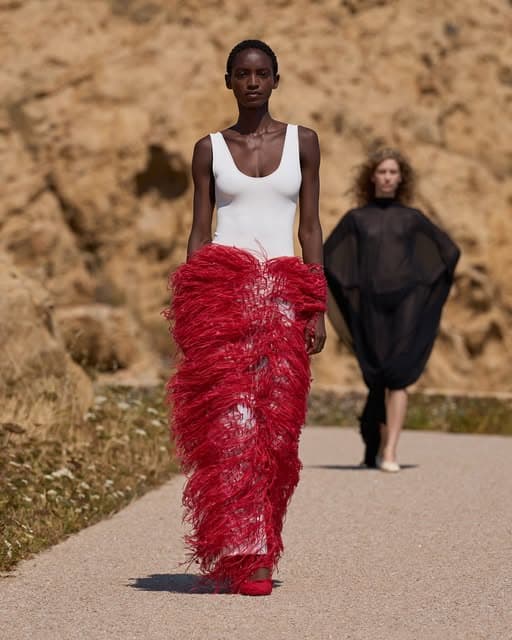
Jacquemus accessories have always been part of the house’s mythology, but here they feel less like internet artifacts and more like finishing strokes. A bag or a shoe does not compete with the clothing. It completes the sentence. This is where Jacquemus is growing up, not abandoning playfulness, but placing it with better timing.
If you want context on the brand’s broader evolution, it is worth revisiting Jacquemus itself, where the visual language is as tightly curated as the runway. For runway reference beyond the brand’s own orbit, the seasonal reporting at Vogue Runway remains an essential map. And for a clear, archive minded index of show imagery and credits, FirstView is still one of fashion’s most useful libraries.
The journey behind “Le Bonheur” and why it lands now
When Simon Porte Jacquemus signs off with love, it does not feel like branding. It feels like a designer who knows that fashion is, at its best, a relationship. The audience is not just consuming a look, they are buying into a life, a sunlit proposition of how to move through the world. These Jacquemus Le Bonheur looks offer escapism, but not in the usual fantasy sense. It is escapism into competence, into clothes that make you feel taken care of.
That is also why the collection resonates beyond the runway. Luxury right now is hungry for pieces that photograph beautifully, yes, but also feel good at dinner, on a terrace, in a taxi, in an ordinary day made slightly ceremonial. If you are thinking about how this kind of wardrobe translates into real shopping habits, our Luxury pages have been tracking the return of investment dressing, the sort that earns its keep without announcing itself.
How to wear the mood without wearing a costume
The smartest takeaway from “Le Bonheur” is not to copy a head to toe runway look. It is to borrow the logic. Choose one strong line, a sculpted shoulder, a clean waist, a long skirt with movement, and keep the rest crisp. Let fabric do the talking. Let skin appear where it feels intentional. Happiness, in Jacquemus terms, is a matter of editing.
For more on the cultural conversation around contemporary French dressing and the way designers are re framing romance, you will find kindred territory in our Culture coverage. “Le Bonheur” is fashion, certainly, but it is also a small manifesto on living well, with taste and with restraint.
Photo Credits
Cover image courtesy of JACQUEMUS. Additional images courtesy of their respective owners.